


From Open Tables to Closed Circles

The Summer House & The Infatuation
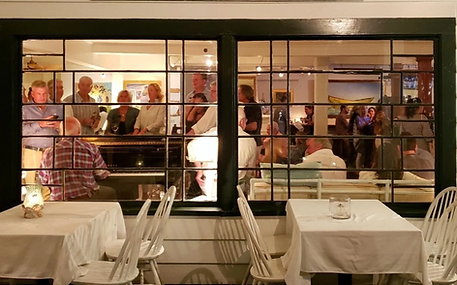
Diners at the Summer House in 'Sconset, and at Galley Beach
Four years after the restaurant closures of 2022, Nantucket didn’t lose its dining scene, it changed who it serves
Kayley Jensen • April 7, 2026
In the spring of 2022, a handful of Nantucket restaurants didn’t reopen. At the time, it felt like a disruption, an unusual season shaped by staffing shortages, housing pressure, and the aftershocks of the pandemic. Keepers closed. 56 Union, The Pearl, The Boarding House, and the Milestone Road location of Lola Burger followed.
Operators pointed to the same constraints: fewer places to house workers, a tighter labor pool, and the growing difficulty of sustaining a seasonal business through an increasingly expensive winter. One local official described it plainly: “Something is out of whack… I believe it’s housing.”
It was framed as a moment, but it wasn’t.
What followed was not a clean recovery, and not a continued wave of closures in the traditional sense. The restaurants came back. New ones opened. Familiar names reappeared under different ownership. On the surface, the island’s dining scene looks active, even busy. But underneath, the structure has changed.
The System Didn’t Collapse. It Shifted.
The easiest way to understand what happened is not in what disappeared, but in what replaced it. Restaurants didn’t vanish. They turned over. Concepts changed, and ownership shifted, but the replacements were not equivalent.
Dune closed after years as a reliable, approachable fine-dining option. In its place came a higher-end concept that reset expectations for that location. Fusaro’s entered a new phase under the weight of a multi-million-dollar valuation. Even long-standing institutions like Straight Wharf expanded into parallel models, splitting between high-end dining and more casual formats.
Taken together, these are not isolated changes. They point to a narrowing center.
For years, Nantucket’s dining scene was defined by a range of options that sat comfortably between casual and high-end places where you could have a good meal without it becoming an event. That layer is thinning. In its place, the market is polarizing.
At one end, high-end restaurants continue to push upward, supported by a customer base that can absorb rising prices and expects a controlled, curated experience. At the other, more casual concepts are optimized for efficiency and volume. What sits in between, restaurants that balanced quality, accessibility, and a sense of place, is becoming harder to sustain.
This is not a stylistic change. It’s economic. As one operator put it in 2022, “the financial numbers don’t work to stay open” in the off-season.
At the same time, a more casual version of that middle is holding. Places like Pi Pizzeria, Pizzeria Gemelle, and Sophie T's Pizza offer sit-down dining without the cost, structure, or planning that now define much of the upper tier. They are accessible, flexible, and increasingly relied on.
But they operate differently. The experience is quicker, the model more streamlined, and the role more functional than social. They are not replacing the middle, they're absorbing the demand that the traditional middle-tier restaurants can no longer fully meet.
And what remains of that traditional middle still matters. Places like Rose & Crown, Brotherhood of Thieves, Crosswinds Restaurant, Island Kitchen, and The Faregrounds Restaurant & Pudley’s Pub continue to serve that role, accessible, consistent, and tied to the year-round community.
But they are carrying more weight than they used to.
The Reservation Economy
At the same time, the way people access restaurants has changed just as dramatically as the restaurants themselves.
What was once a fluid, social, and often spontaneous part of Nantucket life has become increasingly structured. Reservations, once recommended, are now required at many places, including for bar seating. Many high-end restaurants now require a credit card on file and impose cancellation fees, often around $50 per person, for late changes or no-shows.
Dining has shifted from something flexible to something scheduled. Access is no longer just about where you go, but how early you planned to be there.
Where the Talent Went
Behind the scenes, another shift is reshaping the industry in ways that are less visible but more consequential.
Restaurant operators have consistently pointed to staffing as their most intractable problem — particularly in kitchens, where experience matters most. But the talent hasn’t actually left the island; in many cases, it has simply moved behind the hedges.
A parallel market has grown alongside the restaurant system, and on Nantucket, that shift is increasingly visible. A growing number of private chef and catering services now operate across the island, forming a second layer of dining that exists outside the traditional restaurant model.
Many of the chefs leading this work are not newcomers. They are experienced professionals with backgrounds in well-known Nantucket kitchens. Chef Colin Coyle, former Chef at The Club Car, now focuses on private dining through The Private Plate. Chef Kimmy Freudenreich, whose time in the kitchens of The Pearl, The Boarding House, and Cru placed her inside some of the island’s most recognized restaurant groups, has built CHEFKIMMY into a standalone private brand.
Others reflect a similar shift in a different direction. Chef Kaity Farrell, whose work at The Beet and Island Kitchen centered on seasonal, plant-forward cooking, now operates Fare Isle, bringing that same approach into smaller, curated settings. Alongside them are independent operators like Dani Coleman, whose background in private and yacht-based cooking represents another pathway entirely.
Together, these businesses — along with larger-scale operations like On Island Chefs, Nantucket Catering Company, and PPX Events — form a parallel dining economy that runs alongside the public one.
The appeal is straightforward. Private work can offer a more controlled environment, more predictable income, and, in many cases, access to housing, something restaurants increasingly struggle to provide. The result is not a disappearance of talent, but a redistribution of it. A larger share of the island’s culinary workforce now operates outside the public restaurant system, leaving many kitchens to function with smaller teams and tighter margins for error.
What has changed is not just who is cooking, but where that work is happening, and who has access to it


From left: Chefs Kaity Farrell, Colin Coyle, Dani Coleman, and Kimmy Freudenreich (CHEFKIMMY), part of Nantucket’s growing private chef and catering landscape reshaping how — and where — the island eats.
Where It’s Moving
You can see the direction of this shift reflected beyond restaurants themselves. Events like the Nantucket Wine & Food Festival increasingly center around private, high-cost experiences, dinners held in homes, curated gatherings, and limited-access events that operate outside the traditional dining room.
At the same time, a different kind of adaptation is happening mid-island. Shared commercial kitchens like the Hive (backed by ReMain Ventures) at 5 Amelia Drive have created space for smaller, independent food businesses to operate without the burden of a full-service lease.
Vendors like Siam to Go, Marmitaria Sabor de Minas, and Noemi's Dumplings, along with a rotating mix of prepared food concepts and pop-ups, are able to build a following, test menus, and operate on their own terms.
The model is intentionally flexible. Some businesses use the space as a launch point. Others treat it as a long-term base, supplying takeout, catering, or direct-to-consumer meals without ever opening a traditional dining room. What’s on offer can shift over time, but that flexibility is the point.
The result is another layer of the island’s food economy, less visible than Main Street, but increasingly active.
It’s not a replacement for sit-down restaurants, and it doesn’t offer the same kind of experience. But it serves a different purpose. It lowers the barrier to entry, keeps smaller operators viable, and allows new ideas to take hold in a market where the cost of opening a full restaurant has become increasingly difficult to justify.
The Year-Round Illusion
All of this is happening against a backdrop that hasn’t changed: demand remains high. Summer traffic is strong, and the shoulder seasons are busier than they were a decade ago. There is no shortage of people who want to dine on Nantucket. What has changed is the system’s ability and, willingness, to serve them in the same way.
The winter months make that especially clear. Restaurants that once tried to maintain a year-round presence are now closing for extended stretches in January and February or operating on reduced schedules. In recent seasons, multiple establishments have formally requested extended offseason closures, reflecting the difficulty of maintaining operations when staffing is limited and costs remain high.
The island may function year-round, but its restaurant economy increasingly does not.
What Changed
None of this points to a collapse. The dining scene has not disappeared. In many ways, it has become more polished, efficient, and more tightly managed. But, it has also become more segmented.
The closures in 2022 were the first visible signs of pressure. What followed was not a reversal, but an adaptation. Restaurants changed hands. Concepts shifted. Hours tightened. Talent moved elsewhere. Prices adjusted. Access narrowed.
The island still eats. But the version of Nantucket where you could walk in, find a seat, and feel like the place was built with the community in mind is harder to find than it used to be.
The “Shrinking Menu” was never just about food. It was about who still has a place at the table.